
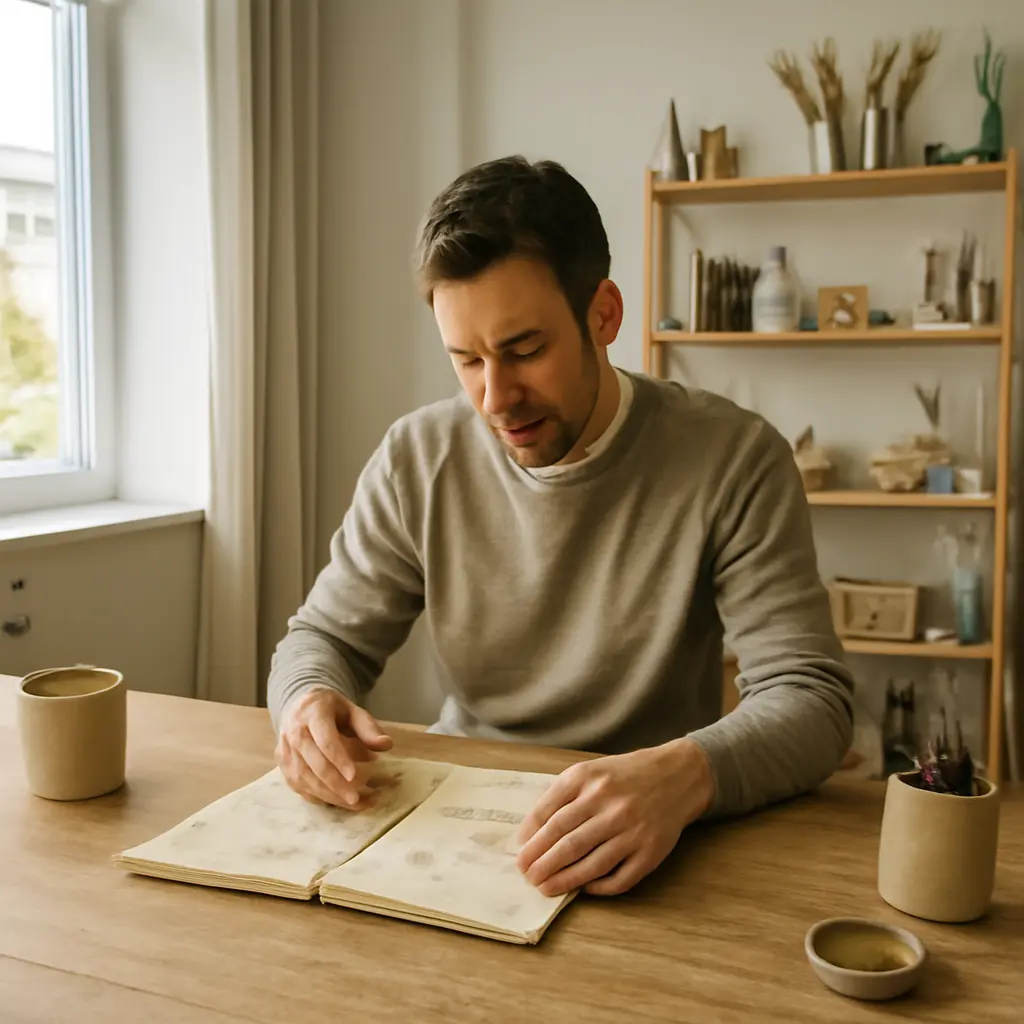
Ideas rarely arrive from nowhere. After a year of chasing projects that seemed novel, I noticed how many led back to childhood: games, places, obsessions, and questions I had carried for decades. That pattern is not proof that every creative idea is a buried memory, but research on autobiographical memory and creativity offers a useful explanation: people often recombine experiences they already know into new possibilities. This account follows that process—from memory and creative recombination to practical ways of testing an idea—while distinguishing personal reflection from scientific evidence.
Childhood memories shape the ideas we pursue
An idea is a mental representation of a possible action, object, story, or solution. A childhood memory is a recollection of an earlier experience, though it is not a perfect recording: psychologists understand autobiographical remembering as a reconstructive process influenced by later knowledge and present concerns. That distinction matters. When an adult idea resembles a childhood pastime, it may draw on remembered feelings or patterns without reproducing an exact event.
In my year of trying ideas, the recurring clues were less like vivid flashbacks than familiar attractions: making things by hand, inventing stories, collecting details, and exploring places. The projects changed, but the underlying pleasures did not. My experience is an anecdotal case, not a survey or proof of a universal rule. Still, it fits a broader account of creativity in which people use existing knowledge and memories as ingredients for something new.
Autobiographical memory is reconstructed, not replayed
Autobiographical memory refers to recollections of one’s life, including specific events and more general knowledge about personal history. Psychologist Martin A. Conway’s work describes autobiographical memory as connected to the self: what people retrieve can help maintain a sense of identity and guide present goals. A remembered childhood activity can therefore matter not only because it happened, but because it still represents curiosity, freedom, competence, or belonging.
The reconstruction involved in remembering also calls for caution. A person may remember the emotional center of an experience more reliably than its exact details, and a current interest can influence which past moments become salient. Finding a childhood connection is meaningful as a prompt for reflection; it does not establish that the memory caused a present-day ambition.
Creative ideas recombine familiar material
Creativity is commonly studied as the production of ideas or work that is both original and useful or appropriate to its context. Researcher Mark A. Runco’s writing on creativity emphasizes that originality alone is not enough: an unusual idea also needs some form of value or fit. Familiar memories can supply material for that process, but they do not guarantee a strong outcome.
A childhood interest may return in a different form. Someone who built elaborate forts might later enjoy designing spaces; a child who invented characters might become drawn to writing, games, or performance. These are possible continuities, not fixed career destinies. The bridge from memory to a viable project still requires experimentation, skills, resources, and feedback.
A year of chasing ideas revealed recurring patterns
The practical value of reviewing a year of projects is pattern recognition. Instead of asking only, “Which idea was best?” it helps to ask what each attempt repeatedly demanded or offered: making, explaining, collecting, performing, solving, or connecting. Those recurring actions can reveal a stronger preference than the surface topic of any single project.
The activity mattered more than the project label
A project label describes the output—an app, newsletter, shop, or film—while an activity describes the work involved. During a year of trying ideas, the same activity can appear under several labels. For example, a person may repeatedly choose projects that involve researching and organizing information, even when the topics differ.
A useful review is to list each idea alongside the part that felt energizing, the part that felt draining, and the reason it was abandoned or continued. This is a reflective tool rather than a validated psychological test. Its purpose is to separate interest in an outcome—such as being recognized—from interest in the ordinary work required to make that outcome real.
Childhood interests can point to enduring motives
A motive is a recurring reason for acting, such as curiosity, mastery, expression, affiliation, or autonomy. Childhood memories can help a person notice these motives because early play often exposes what they chose to do when external expectations were lighter. Yet childhood preferences are clues, not instructions: circumstances, access, culture, and changing abilities all shape what a person can pursue.
For instance, remembering hours spent drawing does not mean an adult must become a professional artist. The more useful question may be what drawing provided: visual problem-solving, quiet concentration, storytelling, or the satisfaction of making something tangible. That underlying motive can be tested in many adult activities.
Memory-informed ideas need real-world testing
A personal connection can make an idea feel compelling, but emotional resonance is different from feasibility or demand. To move from reflection to action, treat the memory as a source of hypotheses: perhaps the enduring interest is teaching, building, collecting, or exploring. Then test the activity in a small, low-cost way before making a major commitment.
Use small experiments instead of waiting for certainty
A small experiment is a limited trial designed to produce evidence. It might mean making one prototype, publishing a short piece, interviewing potential users, attending a workshop, or setting aside a few hours for the core activity. The goal is not to prove that a childhood memory predicts success, but to learn whether the present-day version of the work is satisfying and useful.
This approach also guards against romanticizing the past. A child may have loved an activity because it was playful and pressure-free; turning it into a job can introduce deadlines, costs, and evaluation. A trial makes those differences visible before nostalgia is mistaken for a business plan or career forecast.
Track evidence, not just excitement
After each trial, record what happened: time spent, obstacles encountered, feedback received, willingness to continue, and whether anyone else found the result useful. Excitement is relevant, but it is only one signal. Repeated effort and constructive response provide additional evidence about fit.
A simple visual aid can make the pattern clearer: create a timeline of the year’s projects, then mark each with its main activity and the childhood memory or interest it recalls. The resulting chart is not scientific measurement, but it can reveal clusters that are hard to see when ideas are considered one at a time.
Conclusion: childhood memories are clues, not blueprints
A year of chasing ideas can reveal that many new ambitions echo old pleasures. Autobiographical memory helps people make sense of their lives, and creative work often draws on familiar material, but neither fact proves that childhood determines an adult’s path. The useful discovery is the recurring activity or motive beneath the projects.
Look back at the ideas you have pursued, identify what repeatedly held your attention, and run a small experiment before making a large commitment. Treat the past as a source of questions—not a verdict—and let present-day evidence show which memories are worth turning into work.
Sources: Conway, Martin A., “Autobiographical Memory,” in Memory, 1990; Runco, Mark A., “Creativity: Theories and Themes: Research, Development, and Practice,” Elsevier, 2014