
Believable weird spaces are uncanny, impossible, or unfamiliar settings that still obey enough consistent rules for readers to understand how characters move through them and what those places mean. For novelists, the overlooked skill is not merely inventing strangeness; it is making strangeness legible. Research on narrative comprehension shows that readers build mental models of story worlds, while architectural wayfinding research identifies landmarks, routes, and spatial organization as key aids to navigation. Those ideas offer a practical framework for designing surreal settings: establish rules, provide orientation, connect space to character, and let anomalies change the story. The result is a world that can unsettle readers without losing them.
Believable Weird Spaces: The Narrative Attribute of Spatial Coherence
Spatial coherence is the quality that lets a reader form a workable sense of where events happen and how one place relates to another, even when the setting is impossible. It does not require realism. A hallway may stretch for miles, a house may contain a winter landscape, or a city may rearrange itself nightly. The space feels believable when the novel gives readers enough stable cues to infer its rules and enough continuity to see the consequences when those rules bend.
Cognitive scientists Raymond A. Mar and colleagues describe readers as constructing situation models of narratives: mental representations that integrate events, characters, time, and location. In the 2008 journal article “Bookworms versus nerds,” Mar and colleagues reviewed research connecting fiction reading with social and cognitive processes; related narrative-comprehension work treats spatial setting as part of the situation readers track. The useful craft implication is modest but powerful: readers do not need a surveyed floor plan, but they do need a stable enough mental model to follow action and notice meaningful disruptions.
Wayfinding research offers another lens. Kevin Lynch’s 1960 study of urban imageability identified five recurring elements in how people mentally organize cities: paths, edges, districts, nodes, and landmarks. These concepts translate neatly to fiction. A path might be a stairwell; an edge, a forbidden boundary; a district, a region with its own rules; a node, a meeting place; and a landmark, the feature readers use to orient themselves. In a weird setting, these anchors make the impossible navigable.
Rule consistency: impossible does not mean arbitrary
Rule consistency means that a setting’s supernatural or surreal effects recur in patterns readers can recognize. The rules can be incomplete, mysterious, or changing, but the story should signal whether a change is a genuine exception, a character’s misunderstanding, or a new condition. If a door opens only when someone forgets a name, for example, the reader can anticipate and interpret what happens when a character tries it.
This principle is related to “consistency” in worldbuilding and to causal reasoning in narrative comprehension. Readers tend to search for relationships between actions and outcomes; repeated spatial effects teach them what to expect. A useful test is to ask whether a scene’s outcome feels surprising in retrospect rather than random. The former rewards attention; the latter can weaken trust in the story’s internal logic.
Orientation: landmarks, paths, and thresholds
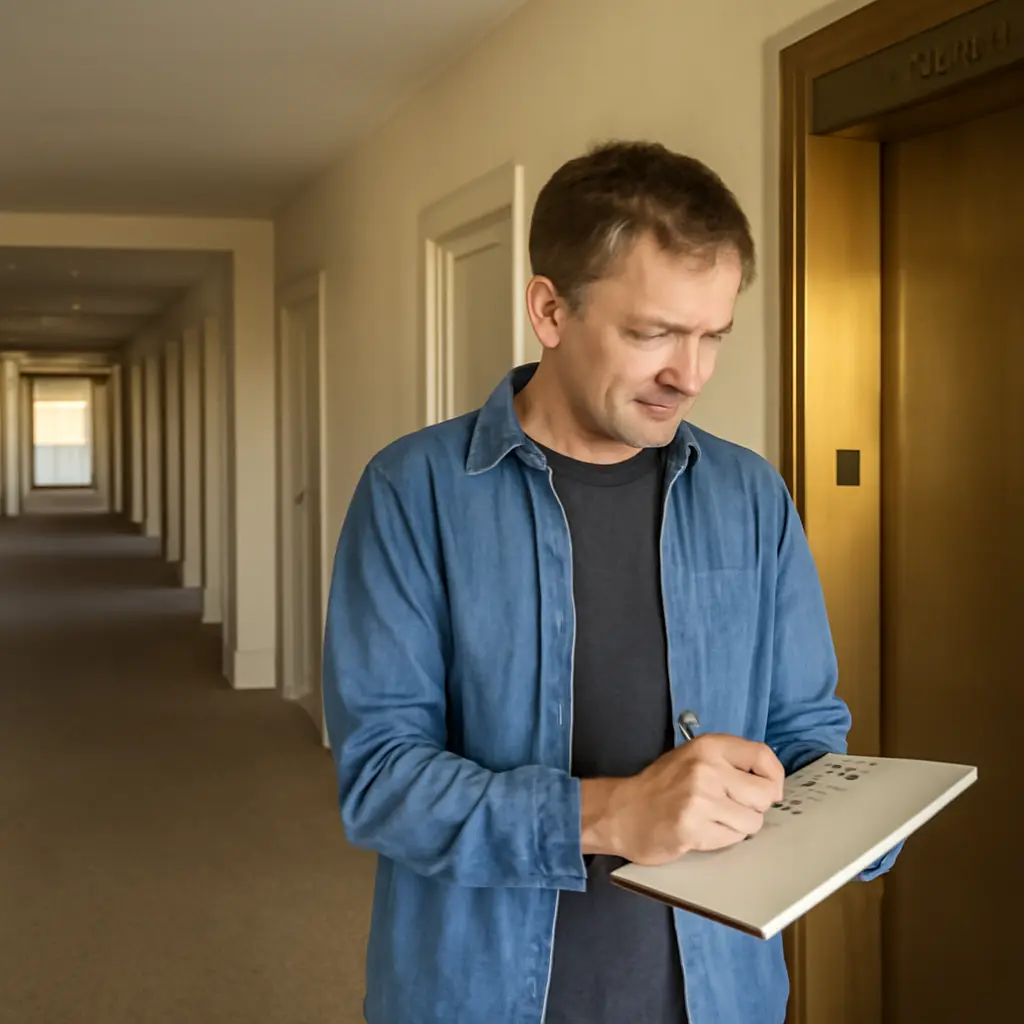
Orientation is the information that helps readers locate a character in relation to other places. Lynch’s landmarks, paths, edges, districts, and nodes can serve as a compact design checklist. In a shifting hotel, the brass elevator may be a landmark, the service corridor a path, the guest floors separate districts, and the elevator’s refusal to stop on the thirteenth floor an edge or threshold.
These cues need not appear as a map or a block of exposition. A character can notice the green carpet leading toward the kitchens, recognize a bell that rings only near the exit, or realize that every window faces the same moon. Repetition helps readers retain orientation; variation gives the setting meaning. A textual “map” can be useful for a complex sequence, but a few memorable cues often do more than exhaustive measurements.
Sensory continuity: making space feel inhabited
Sensory continuity is the recurring pattern of sights, sounds, textures, smells, and physical sensations that makes a place feel present across scenes. A room may be impossible in shape yet convincing in experience: the air tastes metallic, the floor gives slightly underfoot, and a distant pipe knocks whenever the lights dim. Such details act as orientation cues while also setting mood.
Sensory details work best when selective. Readers do not need every surface catalogued; they need a few details that matter to the character or the action. A cold draft can reveal a hidden passage, the smell of wet stone can mark a border, and an acoustically dead corridor can make a character feel cut off. The strange becomes credible when it affects the body as well as the imagination.
Believable Weird Spaces: The Narrative Attribute of Productive Anomaly
Productive anomaly is a deliberate break from a setting’s established spatial expectations that creates a consequence. Weird fiction, fantasy, horror, and magical realism often depend on anomalies: spaces that contradict ordinary geometry, time, or physical law. Their effectiveness depends on contrast. A reader must first have some sense of what normally happens before a deviation can register as uncanny, threatening, comic, or wondrous.
Tzvetan Todorov’s influential account of the fantastic, published in The Fantastic: A Structural Approach to a Literary Genre, centers on hesitation: the uncertainty over whether an apparently impossible event has a natural explanation within the story or requires a supernatural one. Not every strange-space novel needs to preserve that uncertainty, but Todorov’s framework highlights a useful choice for writers. Decide whether the reader should question the anomaly, accept it as part of the world, or learn its explanation gradually.
Impossible geometry: bends, loops, and mismatched interiors
Impossible geometry occurs when a setting violates ordinary spatial expectations: a room is larger inside than outside, a corridor returns to its starting point, or a staircase descends into a sky. The key is to give the violation a readable pattern. If a loop repeats, vary a detail on each pass; if an interior exceeds its exterior, let a character test the mismatch and respond to the result.
A classic real-world reference is the Winchester Mystery House in California, whose tours and architectural history are associated with unusual staircases, doors, and passageways. The house is not literally supernatural, but its irregular design demonstrates how architectural surprise can shape a visitor’s expectations and sense of orientation. In fiction, the same principle can be heightened: odd construction becomes a narrative system when characters must use, avoid, or interpret it.
Shifting spaces: change with a pattern and a cost
A shifting space changes its layout, access, or destination over time. To keep it intelligible, writers can establish a trigger, a rhythm, or a cost: rooms move at midnight, doors follow a character’s memories, or a corridor rearranges itself whenever someone lies. The reader may not know the full mechanism, but recognizable conditions make the uncertainty purposeful.
Shifting settings can externalize emotional or social pressures. A house that grows more difficult to navigate as a family hides a secret turns architecture into a pressure system. The setting’s changes then serve both plot and theme. A useful craft check is to ask what a character risks by entering, leaving, or returning. If spatial change carries no consequence, it may be decorative rather than dramatic.
Threshold spaces: doors, borders, and transitions
A threshold space marks a transition between states: a door between ordinary life and a hidden world, a bridge between districts, or a stairwell where time behaves differently. Thresholds are powerful because readers can understand the basic action—crossing—while remaining uncertain about what lies beyond. The boundary itself can carry rules, rituals, or risks.
Anthropologist Arnold van Gennep used the concept of rites of passage to describe transitions structured around separation, liminality, and incorporation. Though developed to study social ritual rather than fictional architecture, the framework helps writers shape spatial journeys: a character leaves a familiar place, enters an in-between zone, and emerges changed or newly situated. The bridge from spatial design to character development is therefore direct: crossing a boundary can become an event in the plot, not merely a change of scenery.
Believable Weird Spaces: The Narrative Attribute of Character Connection
Character connection is the relationship between a setting’s spatial features and a character’s goals, memories, fears, or social position. A strange place feels more consequential when it does something to someone: blocks a route, conceals evidence, exposes a private memory, or offers a refuge that comes with a price. This turns description into action and prevents the setting from becoming a disconnected display of oddities.
Environmental psychology distinguishes between physical settings and the meanings people attach to them. In fiction, that distinction lets two characters experience the same room differently. A locked archive may represent safety to one and captivity to another. The writer can preserve the room’s physical facts while changing its emotional meaning through viewpoint, history, and purpose.
Emotional geography: place as memory and mood
Emotional geography is the way a character’s feelings and memories organize their experience of place. A childhood bedroom might seem impossibly large to someone returning after years away; a familiar street may feel alien after a betrayal. The space does not have to change objectively for its meaning to change, although speculative fiction can make that emotional shift literal.
This approach gives description a point of view. Instead of listing every feature in a room, select the details the character would notice under pressure. A frightened character may track exits and shadows; a grieving character may fix on an abandoned cup. These observations make spatial detail do double duty: they orient the reader and reveal the observer.
Spatial obstacles: making setting shape plot
A spatial obstacle is a feature of the environment that complicates a character’s attempt to act. It may be a corridor that lengthens, a stairwell that separates allies, a room that erases sound, or a door that opens only for someone willing to leave an object behind. The obstacle should change the available choices, not merely delay the scene.
This is where weird-space design meets scene structure. Give the character a concrete goal, make the setting interfere in a specific way, and ensure the response reveals character or creates a consequence. For example, a protagonist who can escape a maze only by abandoning a companion faces a moral problem expressed through architecture. The space is memorable because it forces a decision.
Social space: who can enter, move, and belong
Social space concerns how power and belonging are arranged through access, boundaries, and movement. A city may reserve certain routes for the wealthy, a house may hide servants’ passages, or a dream landscape may admit only people who know a particular song. Such rules can make an invented world feel socially specific rather than strange in the abstract.
Lynch’s districts and edges can be used to show separation as well as orientation. A wall may divide communities; a checkpoint may regulate passage; a public square may be welcoming to some characters and dangerous to others. When writers connect spatial access to status, identity, or exclusion, the setting can carry social conflict without requiring a lecture about the world’s hierarchy.
Believable Weird Spaces: A Practical Method for Novelists
A practical method begins with a clear reader experience, not a complete architectural blueprint. Decide what the space should make the reader feel, what the viewpoint character needs from it, and which rule will govern its most important behavior. Then add enough anchors to make action trackable. This sequence keeps invention focused on story rather than accumulating strange details for their own sake.
Build the space in five passes
- Choose the narrative function: refuge, trap, test, revelation, or passage.
- Set one or two core rules that govern movement, access, time, or perception.
- Give the reader stable anchors, such as a landmark, a route, and a boundary.
- Introduce an anomaly that tests those rules and changes the character’s options.
- Revise for continuity: check where characters begin, what they can see, and how they reach each destination.
This process is not a formula for making every setting predictable. It is a way to reserve unpredictability for the moments that matter. When readers know what a place usually does, they can feel the force of what it does now.
Use a scene-level spatial check
Before finalizing a scene, ask: Where is the viewpoint character? What visible or sensory cue helps the reader orient? What route is available? What blocks that route? Which spatial rule is active? What changes by the end of the scene? If those answers are clear to the writer but absent from the prose, add a concise cue rather than a long explanation.
A simple diagram can help when a sequence involves several rooms, entrances, or changing routes. It need not appear in the finished novel. Think of it as a continuity tool, like tracking a character’s injuries or the timing of events. For an intentionally unstable setting, map the changes as well as the baseline: what moved, when, and what the character could know at each point.
Balance explanation with discovery
Exposition is the information a reader receives about how a place works; discovery is the process of learning it through action. A balanced scene may establish one rule directly, then let the character test another. Too little information can make confusion feel accidental; too much can flatten suspense by explaining every mystery before it matters.
A useful revision technique is to mark each spatial detail as orientation, atmosphere, rule, or consequence. If a detail does none of those jobs, consider cutting or repurposing it. The goal is not to eliminate ambiguity. It is to distinguish deliberate mystery from accidental obscurity.
Conclusion: Believable Weird Spaces Strengthen the Whole Novel
Believable weird spaces combine spatial coherence, productive anomaly, and character connection. Lynch’s paths, edges, districts, nodes, and landmarks suggest ways to orient readers; narrative situation models explain why readers benefit from trackable locations; Todorov’s account of the fantastic shows how uncertainty itself can become a deliberate effect. Together, these ideas point to a central craft principle: make the rules legible enough that readers can feel the meaning of their disruption.
For novelists, strange architecture is most powerful when it shapes a choice, reveals a character, or changes the social and emotional conditions of a story. Start with one space, define what it does, choose a few memorable anchors, and test whether its anomalies create consequences. For further reading, explore Kevin Lynch’s The Image of the City, Tzvetan Todorov’s The Fantastic, and research on narrative comprehension and environmental psychology. Then revise a scene by tracing the character’s route through it: the clearer the movement, the more unsettling the impossible can become.
Sources: Kevin Lynch, The Image of the City, 1960, https://mitpress.mit.edu/9780262620017/the-image-of-the-city/; Raymond A. Mar, Keith Oatley, and Jordan B. Peterson, “Bookworms versus nerds: Exposure to fiction versus non-fiction, divergent associations with social ability, and the simulation of fictional social worlds,” Journal of Research in Personality, 2008, https://doi.org/10.1016/j.jrp.2007.04.001; Tzvetan Todorov, The Fantastic: A Structural Approach to a Literary Genre, 1975, https://www.cornellpress.cornell.edu/book/9780801491467/the-fantastic/; Arnold van Gennep, The Rites of Passage, 1909, https://press.uchicago.edu/ucp/books/book/chicago/R/bo3818116.html; Winchester Mystery House, Mansion History, https://winchestermysteryhouse.com/mansion-history/.